


A 1950s airliner is standing guard over the Yukon this fire season. That isn’t a heritage story. It’s what the bottom tier of Canada’s firefighting fleet looks like.
A Lockheed L-188 Electra has spent the early part of June parked at the Whitehorse airport, its tanks holding 11,000 litres of fire retardant, waiting on a wildfire season that keeps starting sooner and running later. The airplane first flew in 1957. Only one other operator anywhere still puts the type to work fighting fire.

When the CBC wrote it up, the angle was the obvious one: a propeller-era airliner, older than most of the people flying near it, pressed back into duty. The more telling fact is why it’s there at all. The Electra is on that ramp not because anyone judged it the best machine for the job, but because the machine that has replaced it across the continent cannot be leased.
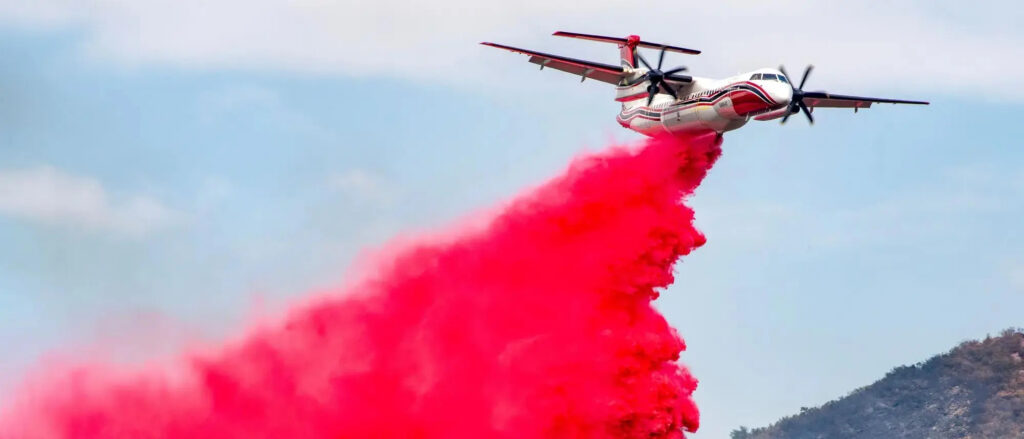
That machine is Conair’s Dash 8-400AT, now the default fixed-wing airtanker across North America. Conair had delivered 27 of the conversions by the end of January, and a government buyer had claimed each one before it rolled out the door. The Yukon never had a place in that line, so it went to the secondary market for what was left: one of the last airworthy Electras, from Air Spray (1967) Ltd. of Red Deer, Alberta.
So the territory is flying a 65-year-old airplane not out of preference but because the alternatives were spoken for. And it has plenty of company at the back of the queue.
A retirement no one planned
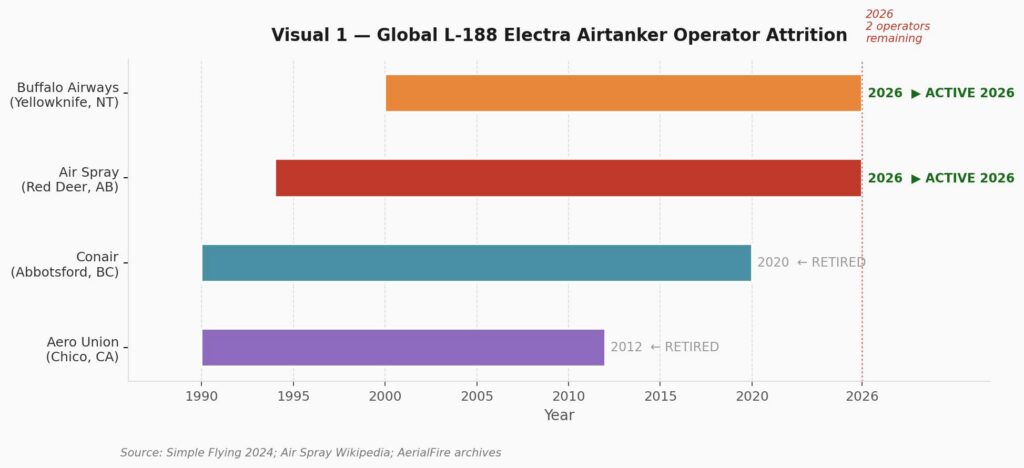
The Electra didn’t so much retire from firefighting as get crowded out. Conair pulled its last one in 2020, years after converting the 1960s airframe into a tanker. Aero Union, which had flown Electras out of Chico, California, shut its airtanker business in 2012. By 2024 the count was down to two operators: Air Spray, and Buffalo Airways, which flies its Electras for the government of the Northwest Territories.
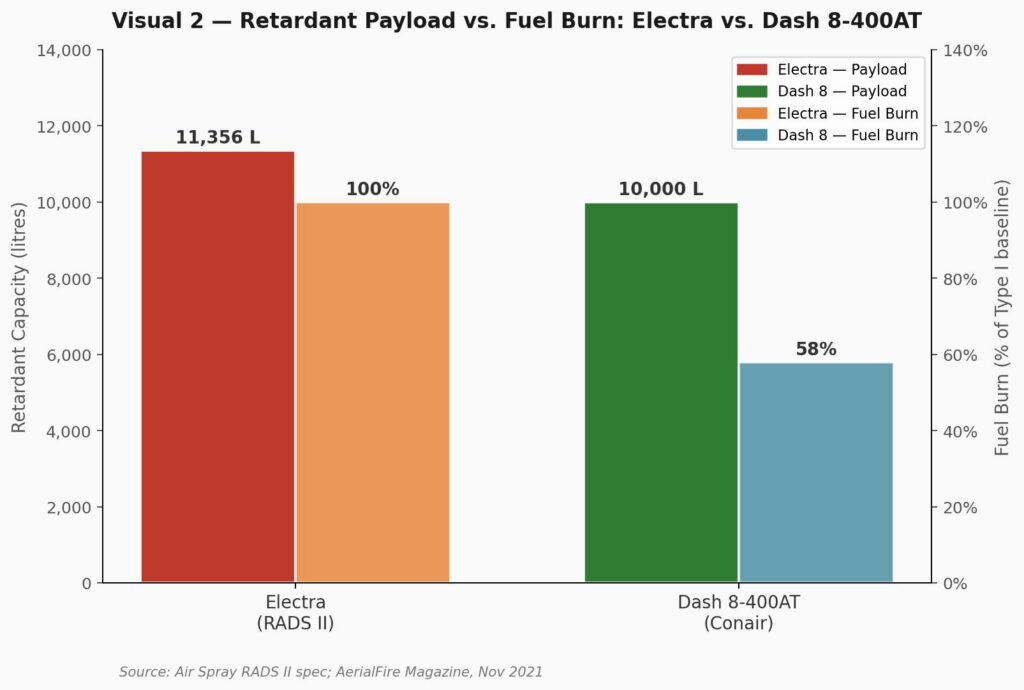
All of that happened while the Dash 8-400AT was climbing, though not really because of it. The newer airplane simply won the argument on numbers. It carries 10,000 litres, close to 90 percent of what a heavy Type I tanker holds, on a little more than half the fuel. It gets in and out of shorter strips, sits closer to the fire and reloads faster. The governments that could line up a Dash 8 did. The ones that couldn’t took whatever the market still had.
The Yukon was one of the latter.
What $9.9 million buys
Julia Duchesne, a spokesperson for the Yukon’s Department of Community Services, told the CBC that airtanker service is costing the territory’s Wildland Fire Management branch roughly $9.9 million this year. The money covers seven aircraft from two private vendors: the Electra, two Rockwell Turbo Commander 690 birddogs and four light airtankers. Only the Electra counts as a heavy tanker, and the territory doesn’t own it. Air Spray does, and leases it out for the summer.
The RADS II tank, for which United Aeronautical Corporation (UAC) owns the IP rights, carries better than 11,000 litres and can drop the load all at once or in measured portions, calibrated to what’s burning below. Air Spray designed the system itself and cleared it with the Interagency Airtanker Board. The tank is modern. The airframe under it is not, and how much longer it can fly is the part nobody outside the company can answer.
The $9.9 million is a single lump figure. It doesn’t break out the Electra’s lease from the rest, and prying that number loose would take an access-to-information request, because none of it is public. The public version is the total: seven aircraft, one season, $9.9 million, no word on what replaces any of it.
Compare Ottawa’s arithmetic. The federal Pan-Canadian Aerial Asset Program, announced May 25, puts $316.7 million over five years toward ten aircraft, four of them Dash 8-400ATs from Conair. Run the first year out and it lands near $63 million, about $6.3 million an aircraft. The Yukon’s works out to something like $1.4 million each, which looks like a bargain until you ask what the cheaper number leaves out: the fuel savings, and a contractor with a replacement aircraft already coming down the line.

The transition that leaves the Yukon out
Air Spray isn’t fading. It’s changing platforms. Next to the Electras it runs BAE 146-200 jets fitted with its own newer tank, the IRADS, a four-engine aircraft that delivers the same kind of precision drop from an internal installation. The company engineered both tanks in-house and owns the patents.
The business logic isn’t hard to follow. The Electras earn money now, in the years it takes to build out the BAE 146 conversion line. Once those jet slots are all under contract, the way the Dash 8 slots already are, the Electra has nothing left to offer. Nobody is going to rebuild it. It goes to the boneyard.
When that happens the Yukon’s options come down to two: pay for a BAE 146 at what a modern jet costs to run, or find a third operator. There is no third operator. Buffalo Airways has its Electras committed to the Northwest Territories, and that fleet is on the same clock.
The case for staying put rests on a couple of true things. The Electra is still certified by Transport Canada, still board-approved, still does the work, and age on its own grounds nothing. Fair enough. But airworthiness rides on maintenance and inspection records specific to the individual airframe, and those aren’t public; nor is there any directive on the books, at least none a member of the public can pull up, setting a fatigue limit for the type in tanker configuration. When this particular airplane has to come out of service is something only Air Spray and the regulator know.
Then there’s the terrain argument. The Dash 8-400AT wants 5,000 feet of pavement, and the Yukon’s fire country doesn’t arrange itself along paved runways. The Electra’s reach over rough northern ground is a genuine edge. Though it’s worth noting that the provincial scooper fleets, the CL-215s and CL-415s, work the same country with no runway at all, filling up off lakes and rivers, which is something neither the Electra nor the Dash 8 can do.
The deadline no one set
Pull back from the airplane-versus-airplane question and the same shape shows up twice. The federal program is a seasonal lease that ends with Canada owning nothing. The Yukon’s is a seasonal lease that ends with no plan at all. Both governments are renting their way from one fire season to the next without putting anything toward the ownership and succession that would make the next ten years less of a scramble.
Ottawa at least has a date to answer to. Its Conair and Coldstream leases run out September 27. Miss that deadline without naming a route to owned aircraft, and the whole lease approach will have run a full cycle and left the country with nothing on its own books.
The Yukon’s bind is quieter and arguably worse. Nothing forces the question, because no lease comes due. The Electra will keep flying until it can’t, and the territory will keep leasing it until Air Spray says enough. Whenever that last airplane retires, on the operator’s timetable and not the territory’s, the Yukon is going to need either a BAE 146 contract or a federal fleet it can lean on. It has neither now.
That is a conversation worth having before September, not after. There’s no sign anywhere that it has started.
Sources
- CBC News, “1950s passenger airliner converted to airtanker among Yukon’s aerial firefighting fleet,” June 1, 2026.
- Simple Flying, “The 2 Remaining Lockheed L-188 Electra Aircraft Operators,” 2024.
- Air Spray (1967) Ltd., “Land Based Airtankers” and “Airtanker Conversion and Tank Development.”
- AerialFire Magazine, “The Dash 8-400AT — Conair’s Next Gen Air Tanker,” Nov. 1, 2021.
- AerialFire Magazine, “Conair Delivers 27th Dash 8-400 Firefighting Plane,” Jan. 29, 2026.
- Canada.ca, “Government of Canada funds 10 new wildfire-firefighting aircraft,” May 25, 2026.
- USDA Forest Service MTDC, “Ground Pattern Performance of the Airspray Electra L-188.”
- USFS Standards for Airtanker Operations, 2025.
- MyNews4 / KRNV, “Ask Joe: How much do those firefighting planes cost to operate?”