

Why Leonardo’s Small Transport Is Becoming a Resilience Platform
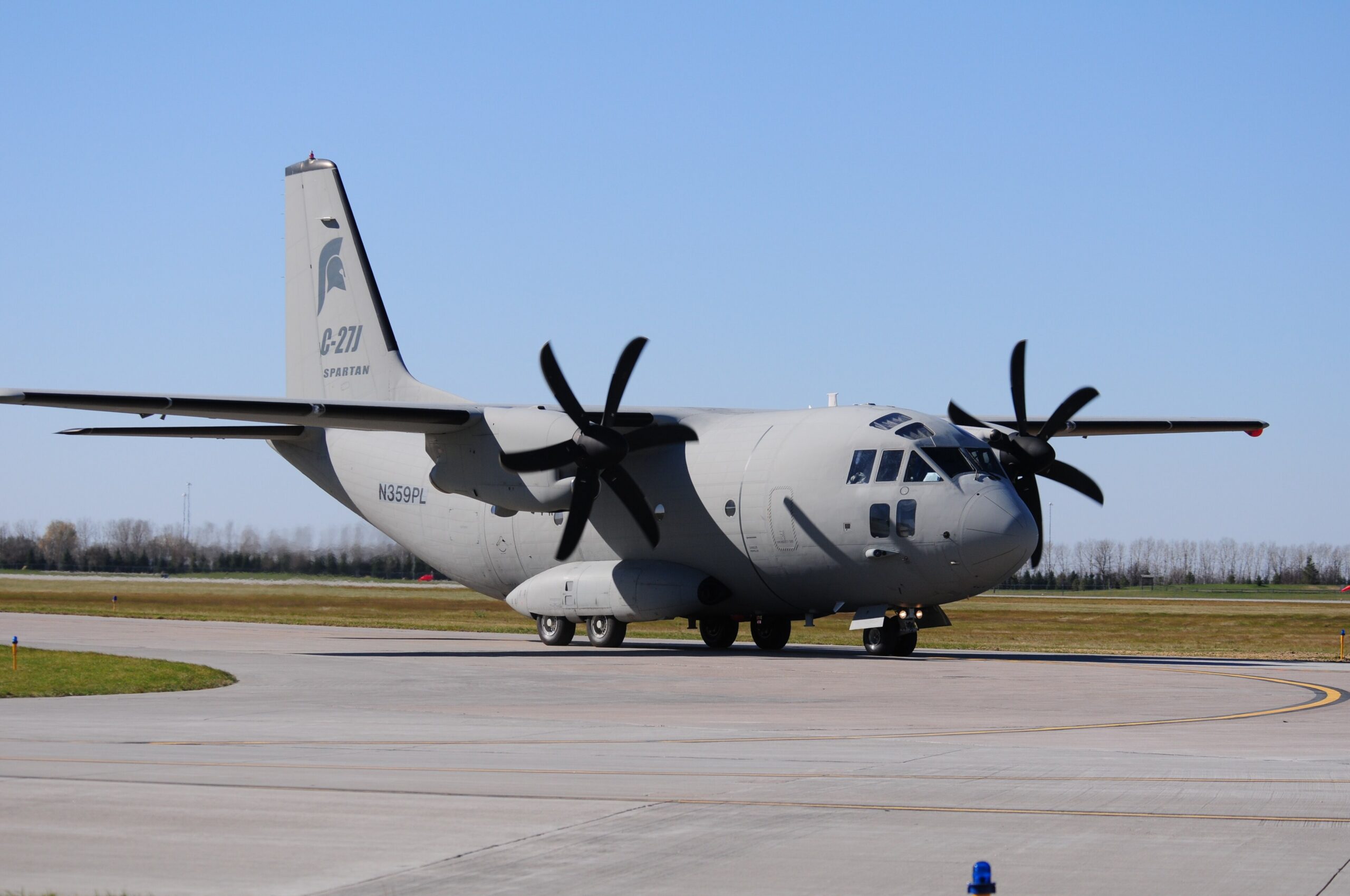
Peru’s decision to buy a fifth C-27J Spartan gives Leonardo a clean headline: 100 aircraft sold. But the number matters for a different reason. The sale shows how the C-27J market is evolving. Leonardo is no longer positioning the Spartan simply as a tactical airlifter. It is increasingly selling the aircraft as a dual-use resilience platform capable of transport, medical evacuation, disaster response, maritime patrol, and aerial firefighting.
A transport aircraft with multiple identities
Leonardo announced on May 14, 2026 that Peru would acquire a fifth C-27J Spartan for the Peruvian Air Force’s Grupo 8, with delivery expected in 2027. The aircraft will become Peru’s first Spartan in the Next Generation configuration. The contract also marked Leonardo’s 100th C-27J order globally, with the company stating the aircraft is now operated by 21 users across 18 countries.
The numbers matter because the Spartan occupies a specific niche in the military and civil aviation market. It can operate from short and austere runways while carrying meaningful payloads into areas where larger transports become operationally inefficient. That makes it attractive to countries that need one aircraft to solve multiple logistical and emergency-response problems rather than maintaining separate fleets.

Peru as the operational proof point
Peru has become one of Leonardo’s strongest real-world demonstrations of the aircraft’s flexibility. According to Leonardo, Peru’s Spartan fleet has accumulated nearly 16,000 flight hours since entering service in 2015. The aircraft have conducted approximately 600 medical evacuation missions, transported almost 240,000 passengers, and moved more than 9,000 tons of cargo.
Peru’s geography forces the fleet to support mountainous regions, remote jungle communities, coastal infrastructure, and humanitarian operations across large distances. In practice, the aircraft has evolved into a national logistics and emergency-response asset rather than a conventional military transport.
The support economy behind the aircraft
The more revealing part of the Peru announcement was not the aircraft itself but the language surrounding support and sustainment. Leonardo stated that the program includes localized support capabilities, autonomous maintenance structures, technology transfer, offset benefits, and training centers.
What Leonardo did not disclose is equally important. The company did not publish the contract value, spare-parts package, depot-maintenance structure, support duration, or long-term sustainment economics. That absence reflects a broader pattern in the military aviation market. Airframe sales attract headlines, but recurring revenue increasingly comes from training, mission systems, software updates, conversion kits, and maintenance infrastructure.
The firefighting push
The C-27J’s expanding identity becomes most visible in firefighting and civil-protection missions. Leonardo now markets a dedicated C-27J Next Generation Fire Fighter configuration integrating a roll-on/roll-off second-generation MAFFS II system developed by United Aeronautical Corporation.
According to Leonardo’s firefighting datasheet, the aircraft can disperse up to 2,100 gallons, or 7,950 liters, of water or retardant. The system is designed for rapid reconfiguration, allowing operators to return the aircraft to transport, humanitarian support, civil-protection, or search-and-rescue roles when firefighting operations conclude.
That flexibility matters financially. Many governments cannot justify maintaining a dedicated aerial firefighting fleet that sits idle outside wildfire seasons. A transport aircraft that can temporarily become an airtanker solves a different budget equation.
How large is the firefighting fleet?
The public record, however, shows a major difference between marketed capability and installed systems. Leonardo actively promotes the C-27J’s firefighting role, but there is no publicly available fleet-wide breakdown identifying how many aircraft actually operate with installed firefighting kits.
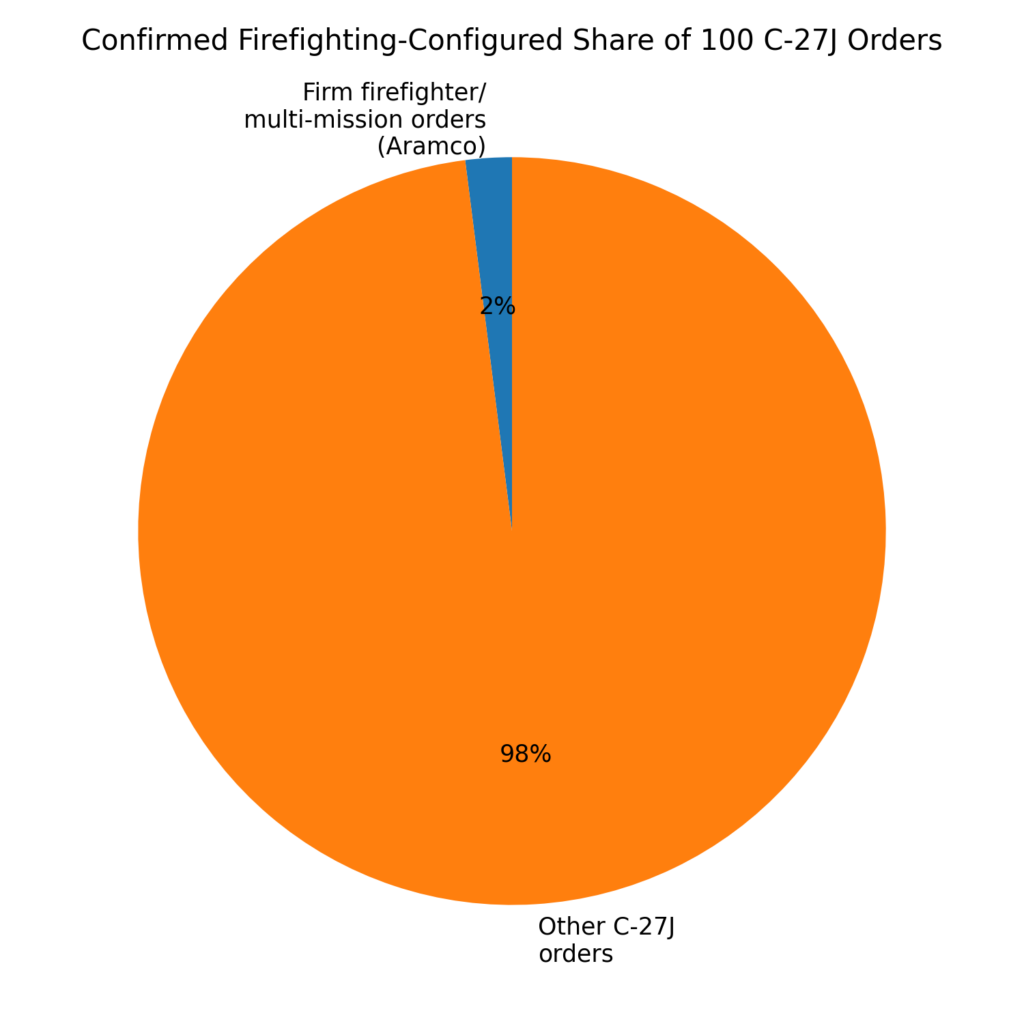
The clearest confirmed order remains Aramco’s acquisition of two multi-mission/firefighter-configured C-27Js announced in 2025. Relative to Leonardo’s 100-aircraft milestone, that represents only 2 percent of the publicly identified fleet.
Other operators, including Peru, describe firefighting as part of the mission profile, but public documentation does not confirm installed systems. The distinction matters because it separates future market opportunities from currently fielded capabilities.
The backlog and future market
The publicly visible backlog floor now stands at roughly seven aircraft. Peru’s fifth aircraft remains pending delivery in 2027. Aramco’s two multi-mission aircraft are also awaiting delivery. Saudi Arabia’s Ministry of Defense separately ordered four maritime patrol C-27J aircraft in February 2026, with deliveries scheduled to begin in 2029.
The direction of the market is becoming clearer. Leonardo is no longer competing only in tactical transport. The company is building a modular mission ecosystem around the Spartan platform. Maritime patrol, firefighting, oil-spill response, humanitarian logistics, intelligence support, and civil protection are all being folded into one aircraft family.

Why the 100th order matters
The real significance of the 100th Spartan order is not the raw sales number. The milestone shows that Leonardo has found demand among countries and organizations that need flexibility more than scale. The aircraft is becoming a platform for resilience operations in regions where governments cannot afford specialized fleets for every mission set.
The next phase of the program will depend less on new aircraft sales and more on sustainment economics. If Leonardo succeeds in building localized maintenance hubs, training pipelines, and rapidly deployable mission-kit ecosystems around the C-27J, the support business may ultimately become more valuable than the aircraft itself.