


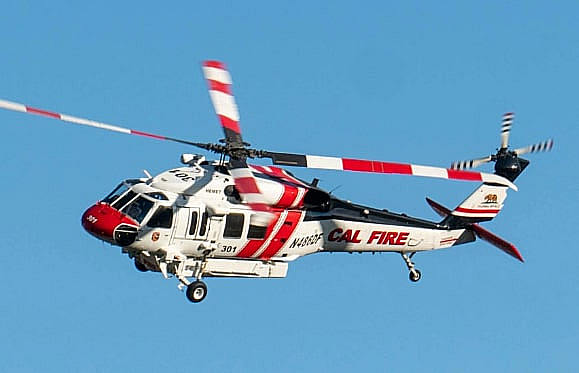
On July 14, PZL Mielec began building Europe’s first S-70 Firehawk, a purpose-built firefighting helicopter constructed for the Czech Republic’s Ministry of the Interior. Lockheed Martin, which owns the Polish plant, announced the start of production the same day. The order looks modest on paper, a single airframe for a single ministry, but it marks something larger: the moment European wildfire agencies stopped treating military Black Hawks as a stopgap and started buying aircraft designed from the ground up to fight fire.

For years, the continent’s answer to a bad fire season has been to call the army. Air forces across Europe fit standard UH-60s with an external Bambi Bucket, fly the mission, then return the aircraft to training and transport duty. It works in a pinch, and Maine’s Army National Guard ran exactly that kind of exercise near Bangor in May, dipping buckets from a lake and dropping 660 gallons at a time at roughly 100 knots. But a bucket-equipped utility helicopter is still a utility helicopter wearing a costume. The Firehawk is not.
What the conversion actually changes
The S-70i Firehawk strips out roughly 940 pounds of the military armor and defensive equipment that a standard Black Hawk carries, according to Fire Apparatus Magazine, and uses that weight margin to fit an internal tank rather than an external bucket. The standard tank holds 1,000 gallons; the extended version holds 1,190. Both cruise at 155 knots, well ahead of a bucket-slung UH-60’s 100 knots, and both refill in under 60 seconds using a snorkel system that lets the aircraft draw water from a lake or reservoir without shutting down or landing.
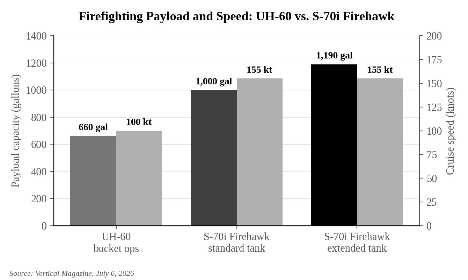
Figure 1. Payload capacity and cruise speed, standard bucket ops versus Firehawk variants.
Put plainly, a Firehawk crew can carry roughly 50 to 80 percent more retardant, fly faster to the fire line, and turn around refills quicker than a bucket-equipped Black Hawk can manage. On a fast-moving wildfire, that difference compounds with every rotation. An aircraft that can complete four drops in the time a bucket rig completes three is not a marginal upgrade. It changes how many acres a single airframe can realistically hold the line on before reinforcements arrive.
Why Poland is building it
PZL Mielec was not starting from nothing. The plant delivered ten S-70i Black Hawks a year in both 2024 and 2025, most recently completing a batch of ten to the Philippines in January 2025. That production line, built for military export customers, is now turning out a civil variant for a European Union member state’s interior ministry rather than a defense ministry, a distinction that matters more than it sounds.
Civil agencies generally cannot use the Foreign Military Sales pathway that governs most cross-border defense procurement. They buy through Direct Commercial Sales instead, a slower, contract-by-contract process that lacks the government-to-government backing FMS provides. European coverage of the Czech order has focused on its symbolism for RescEU, the bloc’s disaster-response reserve, and on Poland’s growing role as a manufacturing hub. What has gotten less attention is that every civil agency following the Czech Republic’s lead will hit the same DCS bottleneck, negotiating aircraft-by-aircraft rather than drawing on the faster procurement channel available to a defense ministry buying the same airframe.
The case against buying one
A Firehawk costs more than 20 million dollars, and that price tag is the strongest argument against it. Smaller European countries with limited annual fire seasons are unlikely to justify a dedicated airframe and its specialized maintenance program when a bucket attachment on an existing multi-role helicopter costs a fraction as much and can be pulled off again once fire season ends. That calculation favors bucket ops for any country whose wildfire risk is occasional rather than chronic, and it is the reason Firehawk adoption in Europe is likely to concentrate in the handful of countries, the Czech Republic among the first, where summer fire risk has become a standing rather than seasonal concern.
The Czech order will not be the last. Lockheed Martin and PZL Mielec built a production line sized for a Philippine military contract, and it is now proving it can pivot to civil orders on a fast timeline. Whether other European interior ministries follow the Czech Republic’s path, or whether budget pressure keeps them buying buckets instead, will become clear as the next fire season tests both approaches side by side.